


Welcome to Postcodes UK
We built Postcodes UK because we felt there was a gap for a straightforward, free resource dedicated entirely to UK postcodes and the places behind them. Whether you need to quickly look up a postcode, understand how the system works, or simply explore what makes different parts of the UK unique, this site is for you.
Postcodes touch almost every part of daily life in the UK. They determine delivery routes, insurance quotes, school catchment areas, council tax bands and much more. Despite their importance, finding clear and reliable postcode information online can be harder than it should be. That is the problem we set out to solve.
What You'll Find Here
Postcodes UK is organised around a few key areas:
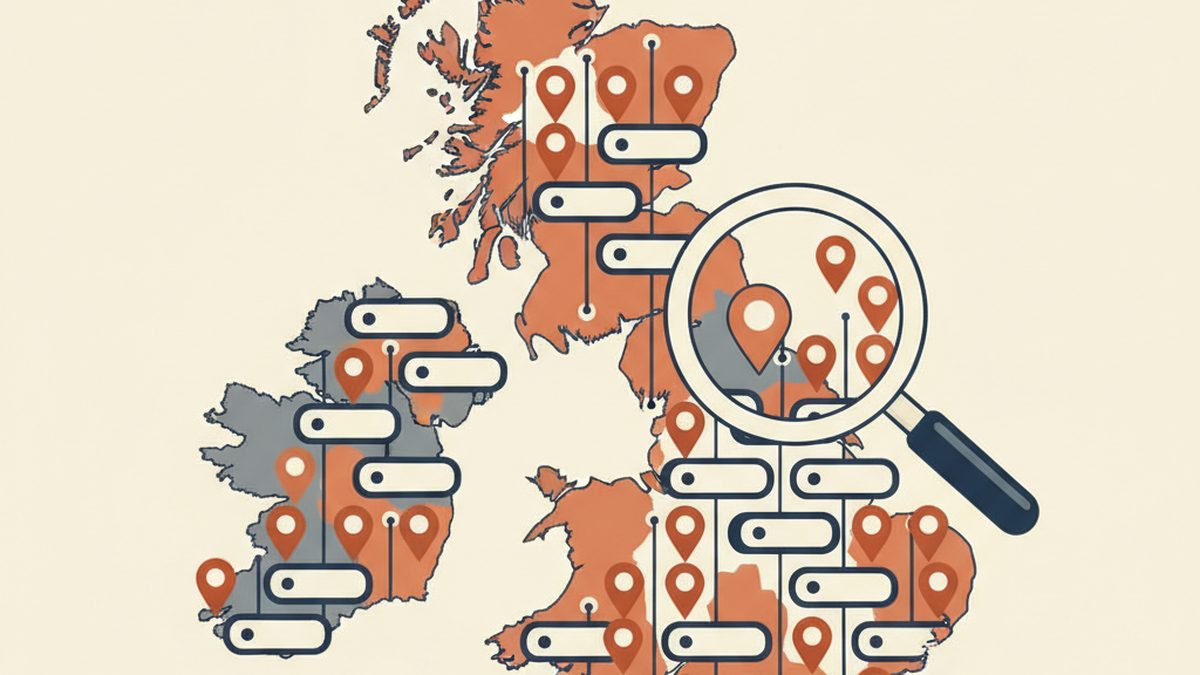
- Postcode lookups: search for any UK postcode to see its location, local authority, county, country and nearby postcodes.
- Area guides: browse by country, county and town to explore the places that postcodes represent.
- Free tools: practical calculators and utilities such as a postcode distance calculator and stamp duty calculator.
- Street-level data: drill down to individual streets and their associated postcodes.
- School information: find schools in any area along with their postcodes and locations.
Everything on the site is free to use with no account required.
How UK Postcodes Work
The UK postcode system was introduced by the Royal Mail in the 1960s and 1970s. Every postcode follows a consistent format that encodes geographic information at several levels:
- Postcode area: the opening one or two letters (e.g. M for Manchester, SW for South West London). There are 124 postcode areas across the UK.
- Postcode district: the area letters plus one or two digits (e.g. M26, SW1A). Districts typically cover a town or part of a city.
- Postcode sector: the district plus a space and the first digit of the inward code (e.g. M26 2). Sectors narrow down to a neighbourhood.
- Full postcode: the complete code (e.g. M26 2RA) which identifies a group of roughly 15 addresses.
On Postcodes UK you can explore every level of this hierarchy. Start from a postcode area and drill down through districts and sectors to individual postcodes and streets.
Exploring Cities, Towns & Villages
Postcodes are not just codes. They represent real places with their own character and history. Our area pages let you browse the UK geographically, starting from the four home nations and working through counties and towns.
Each town page gives you an overview of the area including the postcodes it covers, local streets and nearby schools. It is a useful starting point whether you are researching an area for a house move, planning a visit, or simply curious about a part of the country you have not explored before.
We cover England, Scotland, Wales and Northern Ireland, from major cities like London, Edinburgh and Cardiff down to small villages and hamlets.
Tools & Resources
Alongside the directory itself, we have built a set of free tools designed to solve common postcode-related tasks:
- What's My Postcode: uses your device's GPS to find your current postcode instantly. Handy when you need a quick answer without typing anything.
- Postcode Distance Calculator: enter any two UK postcodes to calculate the straight-line distance between them in miles and kilometres.
- Stamp Duty Calculator: calculate SDLT, LBTT or LTT for property purchases across England, Scotland, Wales and Northern Ireland with up-to-date 2025/2026 rates.
You can find all of our tools on the Resources & Tools page. We plan to add more over time based on what would be most useful.
What's Coming Next
This is just the beginning. We have a roadmap of features and content planned for the months ahead, including:
- More tools and calculators covering common postcode-related tasks
- Expanded area guides with local statistics and demographic data
- Regular blog posts covering postcode news, tips and deep dives into UK geography
- Improved search to help you find exactly what you need faster
If there is something you would like to see on the site, we would love to hear from you. Visit our contact page to get in touch.
Thanks for visiting Postcodes UK. We hope you find it useful.