


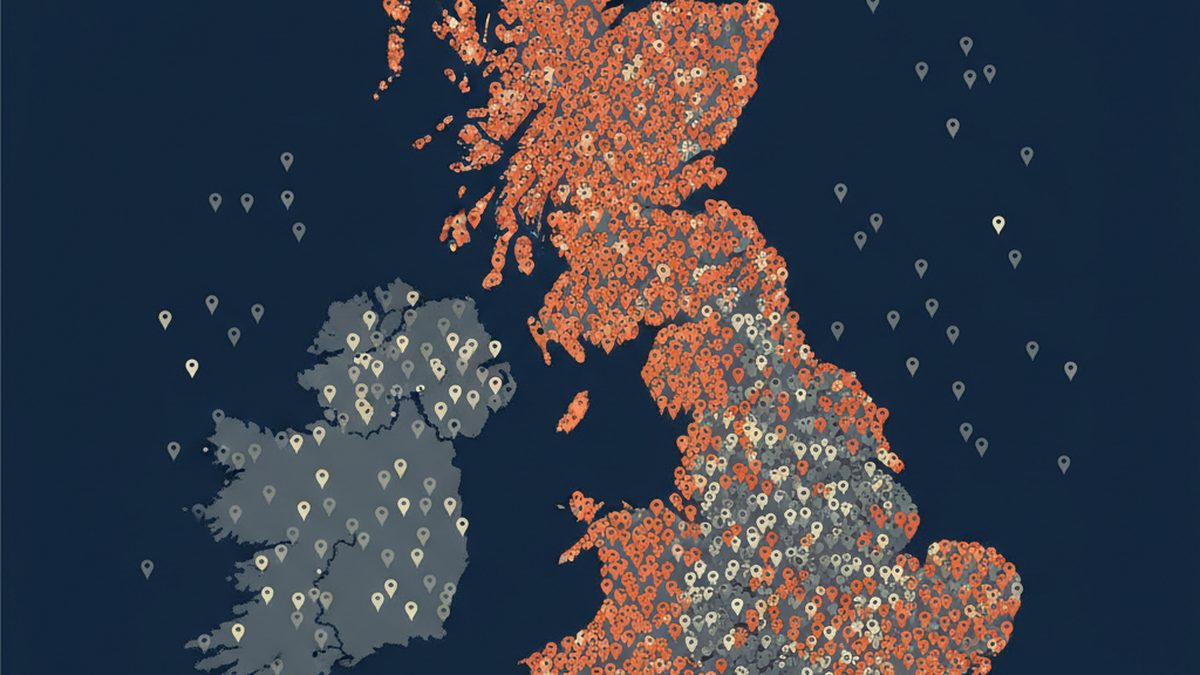
In central London, you can walk past dozens of different postcode units in a single street. In the Scottish Highlands, a single postcode might cover several square miles of open moorland. That gap says a lot about how the UK is built, where people actually live, and how Royal Mail organises its delivery network.
We dug into our database of 1,794,534 postcodes to find the most and least dense postcode areas in the country. Here is what we found.
What Postcode Density Actually Means
When we talk about postcode density, we mean the number of individual postcode units packed into a given area. Each postcode unit typically covers around 15 addresses. In a dense urban centre, those 15 addresses might be a single apartment block. In a rural village, they could span half a mile of scattered cottages and farmhouses.
The number of postcodes in a district is a surprisingly good proxy for how built-up an area is. More postcodes means more addresses, more streets, more buildings. Fewer postcodes means open space, larger properties, or simply fewer people.
The 10 Densest Postcode Districts
These are the postcode districts with the highest number of individual postcodes. Every one of them is in a major urban centre.
| Rank | District | Post Town | Postcodes | Population |
|---|---|---|---|---|
| 1 | CR0 | Croydon | 2,748 | 168,797 |
| 2 | SL6 | Maidenhead | 2,295 | 85,596 |
| 3 | N1 | London | 2,285 | 90,984 |
| 4 | BA2 | Bath | 2,196 | 80,559 |
| 5 | LE2 | Leicester | 2,058 | 119,377 |
| 6 | ST5 | Newcastle | 2,025 | 82,077 |
| 7 | BS16 | Bristol | 2,022 | 88,432 |
| 8 | SE1 | London | 2,012 | 70,026 |
| 9 | NG5 | Nottingham | 1,917 | 89,787 |
| 10 | RH10 | Crawley | 1,905 | 74,234 |
The pattern is clear. London dominates, but other major cities like Birmingham, Manchester and Leeds also feature. These are places where streets are short, buildings are tall, and every block of flats gets its own postcode unit.
The 10 Most Spread-Out Postcode Districts
At the other end of the scale, these districts cover vast areas but contain relatively few postcodes. Many are in the Scottish Highlands, island communities, or remote rural parts of England and Wales.
| Rank | District | Post Town | Postcodes | Population |
|---|---|---|---|---|
| 1 | CT50 | Folkestone | 11 | N/A |
| 2 | EH36 | Humbie | 11 | 383 |
| 3 | EH38 | Heriot | 11 | 394 |
| 4 | IV53 | Strome Ferry | 11 | 153 |
| 5 | SA36 | Glogue | 11 | 366 |
| 6 | KW5 | Latheron | 12 | 310 |
| 7 | M99 | Manchester | 12 | N/A |
| 8 | ZE3 | Shetland | 12 | 863 |
| 9 | IV45 | Isle of Skye | 12 | 1,031 |
| 10 | LE21 | Leicester | 12 | N/A |
These districts tell a different story. A postal worker here might drive for miles between deliveries. The postcodes exist not because there are many addresses, but because the addresses that do exist are spread across a large geographic area.
Postcode Areas With the Most Postcodes
Zooming out from individual districts, we can look at the broader postcode areas (the one or two letter prefix). Which areas contain the most postcodes overall?
| Rank | Area | Districts | Total Postcodes | Population |
|---|---|---|---|---|
| 1 | BT | 80 | 49,943 | 1,903,168 |
| 2 | B | 78 | 41,842 | 2,029,280 |
| 3 | S | 51 | 34,116 | 1,389,843 |
| 4 | NE | 64 | 33,591 | 1,194,876 |
| 5 | G | 55 | 32,168 | 1,234,779 |
| 6 | M | 46 | 32,146 | 1,273,372 |
| 7 | NG | 31 | 29,391 | 1,224,637 |
| 8 | PE | 36 | 27,228 | 972,223 |
| 9 | BS | 39 | 27,211 | 1,034,255 |
| 10 | EH | 57 | 24,928 | 941,243 |
The largest areas by postcode count tend to be those covering major metropolitan regions with extensive suburban sprawl. They contain dozens of districts, each with thousands of individual postcodes.
The UK's Smallest Postcode Areas
Some postcode areas are remarkably compact. These are the areas with the fewest total postcodes.
| Rank | Area | Districts | Total Postcodes | Population |
|---|---|---|---|---|
| 1 | GIR | 1 | 1 | N/A |
| 2 | ZE | 3 | 652 | 22,978 |
| 3 | HS | 9 | 975 | 26,706 |
| 4 | KW | 16 | 1,854 | 52,422 |
| 5 | LD | 8 | 2,216 | 49,657 |
| 6 | WC | 14 | 2,596 | 30,404 |
| 7 | JE | 4 | 3,261 | N/A |
| 8 | GY | 10 | 3,339 | N/A |
| 9 | EC | 27 | 3,691 | 39,517 |
| 10 | SM | 7 | 4,357 | 233,432 |
Island communities and small urban centres dominate this list. These areas may be geographically large but serve relatively small populations.
Why Density Varies So Much
The variation in postcode density across the UK comes down to a few factors.
Housing type matters. A street of terraced houses generates far more postcodes than a rural lane with a handful of detached properties. High-rise apartment blocks in city centres can contain dozens of addresses within a single building, while a farming community might have one postcode covering several square miles.
History plays a role. Older cities with tight medieval street patterns (like the City of London or central Edinburgh) naturally end up with more postcodes per area because the streets are shorter and more numerous. Planned new towns and suburban developments from the 20th century tend to have longer streets and larger plots, resulting in fewer postcodes per square mile.
Royal Mail's operational needs drive the structure. Postcodes are not drawn on a map by geographers. They are created by Royal Mail to organise efficient delivery routes. A densely populated area needs more granular codes so that postal workers can manage their rounds. A sparsely populated area can function with broader codes because there are simply fewer doors to knock on.
What This Tells Us About the UK
Postcode density is, in many ways, a mirror of British life. The densest areas reflect centuries of urban growth, industrial expansion, and modern redevelopment. The sparsest areas tell the story of remote communities, island life, and landscapes where nature still dominates.
For businesses, understanding postcode density is practical. A delivery company operating in central Manchester faces a fundamentally different challenge to one serving the Outer Hebrides. Insurance companies, property developers, and local authorities all factor postcode density into their planning.
For the rest of us, it is a reminder that the humble postcode carries more information than just an address. It encodes geography, population, history, and the everyday logistics of getting a letter from one place to another.
You can explore the full breakdown of any postcode area, district, or individual postcode using our postcode directory, or use the postcode density checker to compare areas side by side.