



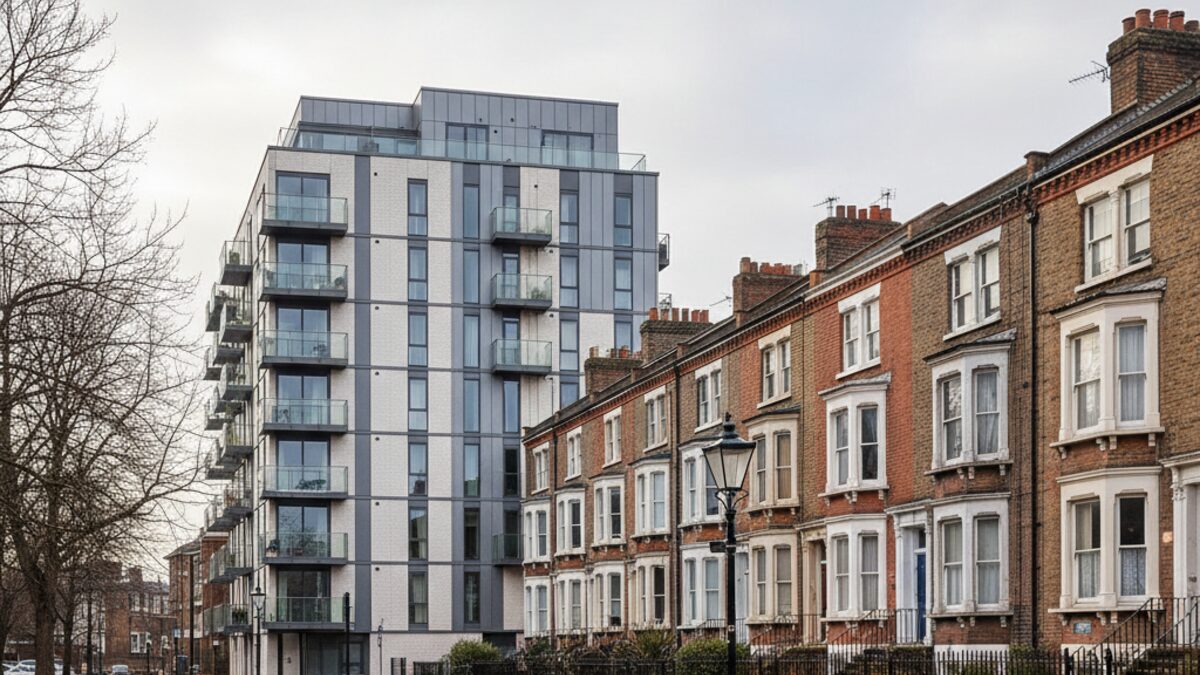
Walk down any street in Britain and the shape of the roofline tells a story. A Victorian terrace in Blackburn, a red-brick semi in Doncaster, a towering mansion block in central London. The choice between a house and a flat is one of the most fundamental decisions a homebuyer makes, and it is a decision that varies wildly depending on where you live. HM Land Registry data, covering all property sales in England and Wales from 2018 to 2026, reveals a country sharply divided by bricks and mortar.
The National Split
Across England and Wales, flats account for just 17.9% of all recorded sales. That means more than four out of five transactions involve a house of some kind: a terrace, a semi-detached, or a detached property. The national average, however, masks a geography of extremes. In some postcode areas, flats are the norm; in others, they are a rare curiosity. The difference is not simply about density or price. It is about history, housing stock, and the very fabric of our towns.
Flat Britain
The flat-heavy areas are overwhelmingly inner London. At the very top sits the EC postcode area, covering the City of London and parts of east London, where flats make up 80.8% of all sales. Just behind is WC (west central London) at 75.9%. The E and W postcode areas of London both stand at 64.9%. In these places, the classic suburban house is a minority pursuit. The housing stock is dominated by purpose-built blocks, converted Georgian and Victorian townhouses, and modern riverside developments. To buy a house in these postcodes is to swim against a strong tide.
| Postcode area | Sales that were flats | Recorded sales |
|---|---|---|
| EC (London) | 80.8% | 6,993 |
| WC (London) | 75.9% | 3,642 |
| E (London) | 64.9% | 100,129 |
| W (London) | 64.9% | 59,957 |
| NW (London) | 63.9% | 51,153 |
| SW (London) | 63.2% | 117,807 |
| SE (London) | 60.3% | 111,952 |
| N (London) | 57.1% | 77,458 |
House Britain
At the other end of the scale, the house-heavy areas are northern and Welsh towns built around terraced housing. The postcode area with the fewest flats is BB (Blackburn), where just 3.1% of sales are flats. It is a similar story in DN (Doncaster) at 3.4%, DL (Darlington) at 3.8%, and TS (Middlesbrough) at 4.0%. Here, the flat is a rare beast. The housing market is dominated by two-up, two-down terraces and three-bedroom semis, the legacy of industrial towns built for mill and mine workers. In Blackburn, for every 100 homes sold, only about three are flats.
| Postcode area | Sales that were flats | Recorded sales |
|---|---|---|
| BB (Blackburn) | 3.1% | 75,596 |
| DN (Doncaster) | 3.4% | 114,488 |
| DL (Darlington) | 3.8% | 58,563 |
| TS (Middlesbrough) | 4% | 92,698 |
| DH (Durham) | 4% | 47,296 |
| LN (Lincoln) | 4.5% | 50,372 |
| WN (Wigan) | 4.8% | 42,570 |
| WF (Wakefield) | 5% | 71,656 |
Why The Divide
The reasons for this split are rooted in history and economics. London's inner boroughs have always been denser, with a high proportion of tenement-style housing and, later, a boom in flat conversions driven by high land values. The city's role as a global financial centre also attracts a transient, higher-income population willing to pay a premium for a central address, often in a flat. By contrast, the towns of the North and Wales grew around industries that required a settled, local workforce. The solution was rows of cheap, sturdy terraced houses, often built by the same mill or mine owner. This housing stock has proven remarkably durable, and the demand for flats in these areas has never really taken off.
What It Means
This divide has real consequences. For a first-time buyer in Blackburn, a house is the default, and a flat is an anomaly. In EC London, the opposite is true. The type of property you buy affects everything from your mortgage costs and maintenance bills to your sense of community and privacy. A flat typically comes with service charges and ground rent, while a house brings the freedom of a front door and a garden, but also the responsibility of a roof and foundations. The data from HM Land Registry is a snapshot of a country where housing is not a single market, but a collection of local markets shaped by deep, local patterns. It reminds us that the question "House or flat?" is not just a matter of taste. It is a question of where you stand on the map. And the answer, for most of us, was decided long before we started looking.