



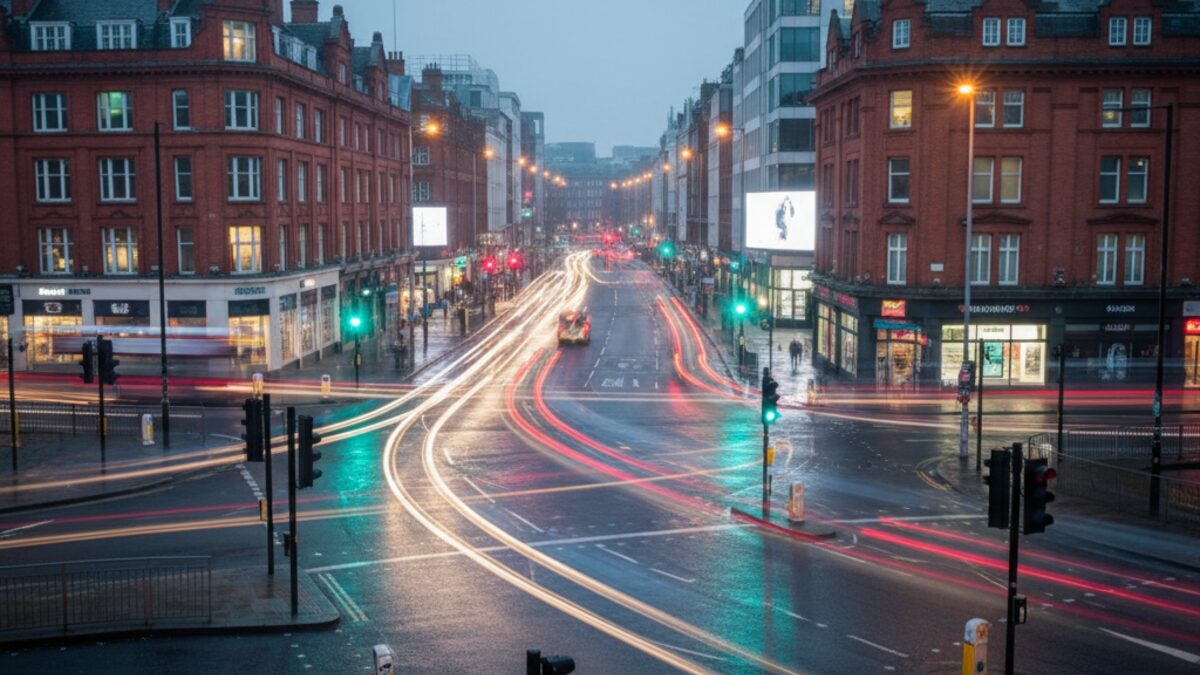
Every year, thousands of personal-injury road collisions are recorded by police forces across Great Britain. The data, known as STATS19, is the official record of these incidents, and it offers a detailed picture of where they happen. By mapping 311,298 collisions to postcode areas using their coordinates, we can see which parts of the country see the most and fewest collisions per resident. The results are revealing, but they come with a crucial caveat: this is a map of traffic volume, not necessarily of danger.
The Data
The figures come from STATS19, the official record of personal-injury road collisions reported to the police, published by the Department for Transport. It covers Great Britain; Northern Ireland is not included. We mapped 311,298 collisions to postcode areas by their coordinates. Across the areas analysed, there were about 478 collisions per 100,000 residents over the period. This gives a national benchmark, but the variation between areas is enormous.
The Hotspots
The areas with the most collisions per resident are all in London. Central London postcode areas dominate the list, reflecting the sheer density of traffic and the huge number of people who travel into them each day. The top four are:
| Postcode area | Collisions | Per 100,000 people |
|---|---|---|
| W (London) | 8,933 | 1,661 |
| SE (London) | 10,018 | 934 |
| CR (Croydon) | 4,123 | 926 |
| NW (London) | 5,282 | 919 |
| E (London) | 10,162 | 911 |
| N (London) | 7,922 | 892 |
| EN (Enfield) | 2,789 | 765 |
| UB (Southall) | 2,770 | 670 |
W (London) leads with 1,661 collisions per 100,000 residents, followed by SE (London) at 934, CR (Croydon) at 926, and NW (London) at 919. These are not necessarily the most dangerous roads for any individual journey, but they are the places where the most collisions happen relative to the number of people who live there.
The Quietest Roads
At the other end of the scale, the areas with the fewest collisions per resident are mostly in Scotland and parts of the Midlands. The lowest rates are:
| Postcode area | Collisions | Per 100,000 people |
|---|---|---|
| AB (Aberdeen) | 661 | 129 |
| IV (Inverness) | 418 | 176 |
| PA (Paisley) | 602 | 184 |
| ST (Stoke-on-Trent) | 1,294 | 195 |
| KY (Dunfermline) | 728 | 196 |
| KA (Kilmarnock) | 745 | 205 |
| FK (Falkirk) | 597 | 211 |
| G (Glasgow) | 2,698 | 219 |
AB (Aberdeen) has just 129 collisions per 100,000 residents, followed by IV (Inverness) at 176, PA (Paisley) at 184, and ST (Stoke-on-Trent) at 195. These areas tend to have lower population density and less through-traffic, which helps explain the lower numbers.
Reading The Numbers Carefully
It is vital to understand what these figures do and do not measure. This analysis counts collisions per resident, not per journey or per mile driven. Dense city-centre areas, especially in central London, come top because huge numbers of non-residents drive through them. Commuters, delivery drivers, and visitors all add to the traffic volume, but they are not counted in the resident population. So a postcode area like W (London) has a small resident population relative to the number of people who travel through it each day, which inflates its collision rate per resident.
This does not mean that a journey through central London is more dangerous than a journey through a rural area. It simply reflects the fact that more collisions happen where more traffic is concentrated. The data is a measure of traffic density and volume, not of the risk per journey. A quiet road in the Highlands might have a very low collision rate per resident, but that does not mean it is safer to drive on than a busy London street.
What It Means
This map is a useful tool for understanding where collisions cluster, but it should not be used to judge the safety of any particular road or journey. The hotspots are, in effect, the places where the most people drive through, not necessarily where driving is most dangerous. The quietest areas are those with less traffic, not necessarily those with safer roads.
For policymakers and road safety campaigners, the data highlights where resources might be focused to reduce the total number of collisions. But for the average driver, the message is simpler: the busier the road, the more likely a collision is to happen. That is not a surprise, but it is worth remembering when you look at the numbers.