



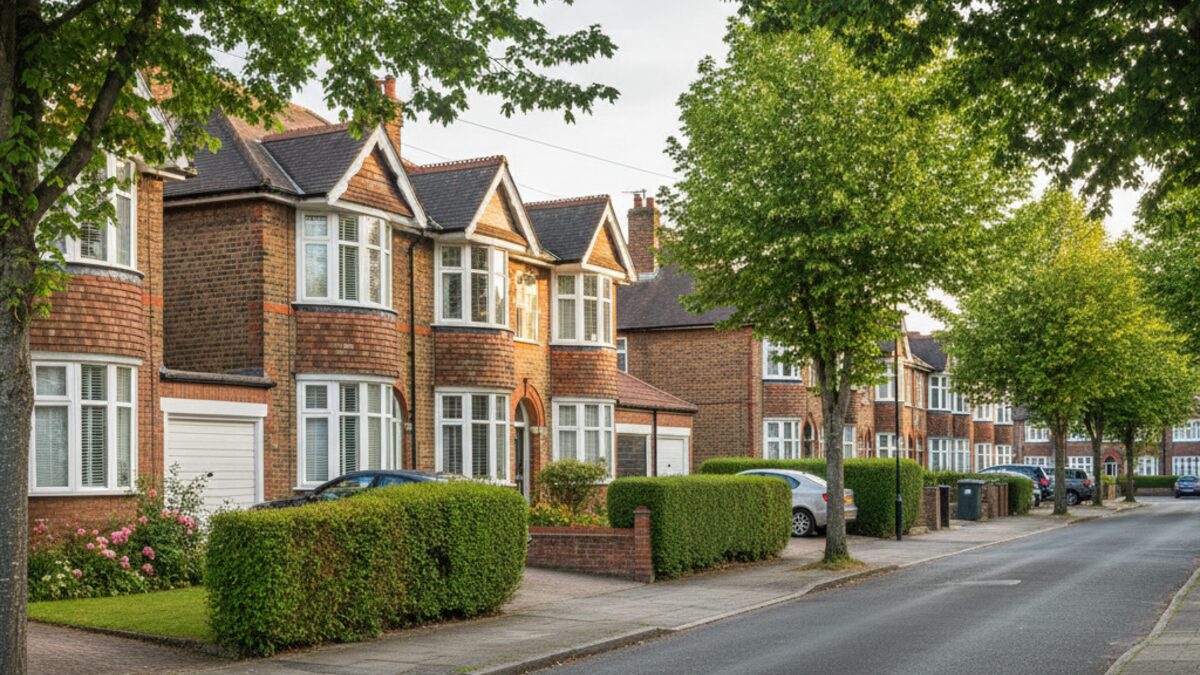
Few home types are as quintessentially British as the semi-detached house. Two front doors, a shared party wall, and strips of front and back garden — no, sorry, no em dashes; let's use a colon: two front doors, a shared party wall, and strips of front and back garden. It is the compromise between the terraced row and the detached dream. And according to HM Land Registry data covering sales in England and Wales from 2018 to 2026, the semi now accounts for 26.8 per cent of all property sales nationally. That figure, however, masks dramatic local variation. In some places the semi is king; in a few it is all but extinct.
The Suburban Standard
The semi-detached house rose to prominence in the interwar years, when private builders and local authorities alike carved new housing estates into the fringes of industrial towns. Its appeal was practical: cheaper than a detached house but offering more privacy and garden space than a terrace. For generations of aspiring homeowners, the semi represented a solid step up the property ladder. It remains the backbone of suburbia, a familiar sight on countless quiet roads. Yet its national share of 26.8 per cent hides the fact that in some postcode areas the semi is far more common, while in others it is a rarity. The geography of the semi is the geography of twentieth-century urban expansion.
The Semi Heartland
The highest concentration of semi-detached sales in England and Wales is found in a corridor running through the West Midlands and Yorkshire. Wolverhampton (WV) leads the way with 39.6 per cent of all sales being semis, closely followed by the Wakefield area (WF) at 37.6 per cent, Walsall (WS) at 37.3 per cent, and Doncaster (DN) at 37.0 per cent. These are the postcode districts where the semi truly dominates the housing market. The heartland stretches from the old industrial towns of the West Midlands — Wolverhampton, Walsall, Dudley — across to the South and West Yorkshire conurbations of Wakefield, Doncaster and Sheffield. Here, interwar suburban estates spread widely, filling the gaps between city centres and the countryside, and their stock of solid, bay-windowed semis remains a fixture of the landscape.
| Postcode area | Sales that were semi-detached |
|---|---|
| WV (Wolverhampton) | 39.6% |
| WF (Wakefield) | 37.6% |
| WS (Walsall) | 37.3% |
| DN (Doncaster) | 37% |
| DY (Dudley) | 36.9% |
| S (Sheffield) | 36.7% |
| FY (Blackpool) | 36.6% |
| WN (Wigan) | 36.5% |
| CH (Wirral) | 36% |
| ST (Stoke-on-Trent) | 35.2% |
Where Semis Are Scarce
The picture could hardly be more different in central London. In the EC postcode area — the City of London — semi-detached homes account for a mere 0.1 per cent of sales. In the WC area (West Central London) the figure is 0.2 per cent, and in the wider East London (E) postcode it climbs only to 3.8 per cent. These are neighbourhoods of flats, conversions and terraced townhouses, where the semi never gained a foothold. The dense, high-value urban core has no room for the modest, generous front gardens and side passages that define the semi. Indeed, across the capital as a whole, the semi is an endangered species. The contrast with the heartland could not be starker: in Wolverhampton the semi is nearly 400 times more common than in the City of London.
| Postcode area | Sales that were semi-detached |
|---|---|
| EC (London) | 0.1% |
| WC (London) | 0.2% |
| E (London) | 3.8% |
| SW (London) | 5% |
| W (London) | 5.8% |
| SE (London) | 7.7% |
| N (London) | 8.5% |
| NW (London) | 10.2% |
Why The West Midlands
The dominance of the semi in the West Midlands and industrial Yorkshire is no accident. In the first half of the twentieth century, these regions experienced rapid population growth driven by manufacturing and mining. Municipal housing programmes and speculative builders alike turned to the semi-detached as the most efficient way to house a growing workforce. The interwar suburbs of places like Dudley and Sheffield were built on greenfield land surrounding factory and pit towns. The pattern proved enduring: later waves of development, including council estates and private developments, continued the semi tradition. Meanwhile, the region's relatively affordable land prices meant plots could be generous enough for semi pairs, in contrast to the cramped conditions of the inner city. The result is a landscape still defined by the rhythm of alternating gables and driveways.
What It Means
The distribution of semi-detached homes across England and Wales tells us something about the country's settlement patterns. Where the semi thrives, we see the legacy of industrial expansion and a particular form of suburbanisation that prioritised the family home with a bit of ground. Where it is rare, we often find either the dense urban core or, conversely, the predominantly detached housing stock of rural and prosperous commuter areas (though the data here focus on sales, not absolute stock). For anyone looking to buy a semi, the West Midlands and Yorkshire offer rich pickings. For those wanting to avoid them entirely, central London is the place. The semi remains a barometer of British housing history, and these figures chart its geography with clarity. It is a story of bricks and mortar, but also of the economic and planning decisions that shaped the suburbs we still inhabit.