



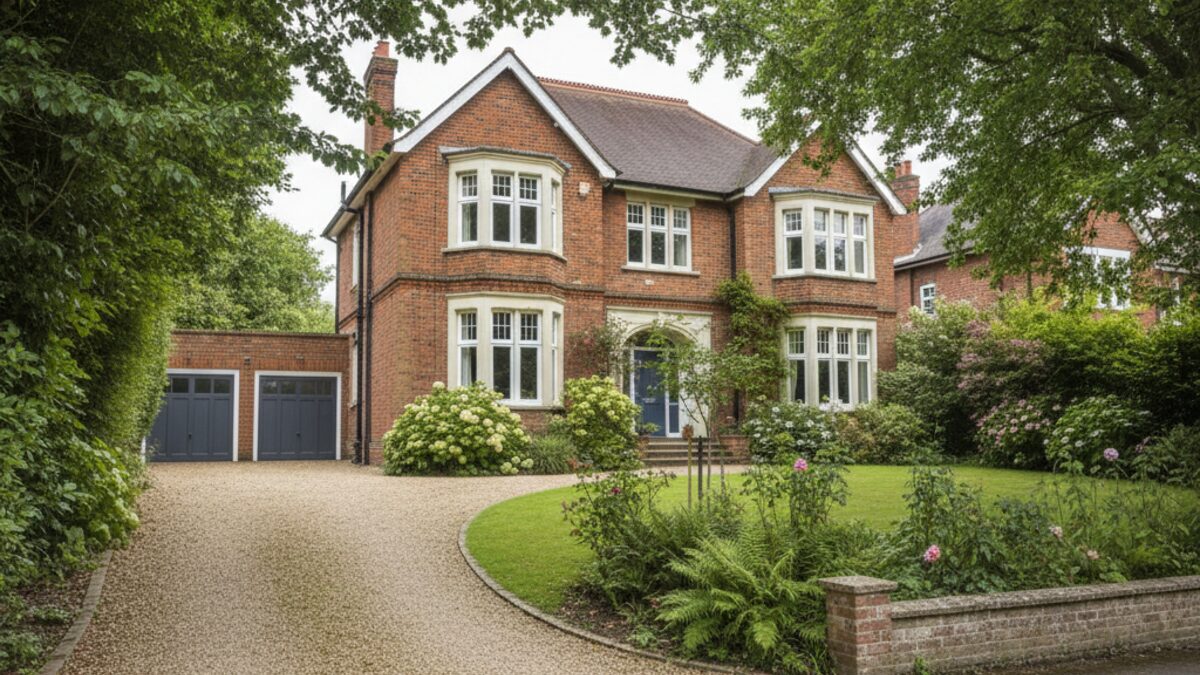
If you have ever browsed property listings in England and Wales, you will have noticed that a detached house almost always costs more than a flat. That is hardly a revelation: more land, more privacy, more space. But the size of that gap varies enormously depending on where you look. In some postcode areas, a detached home costs barely twice as much as a flat; in others, the multiple climbs above four. The difference tells us something about the character of local housing markets, and about what people are really paying for when they buy a house rather than a flat.
The Gap
Using HM Land Registry Price Paid Data for England and Wales, we compared the average sale price of a detached house with that of a flat in each postcode area. The results show a clear pattern: the detached premium is widest in parts of London where grand houses are scarce and extremely expensive, and narrowest in northern cities and some university towns where flats and houses are more alike in size and value. Across the country as a whole, the gap can range from just under two times to more than four times.
The Widest Gaps
At the top of the list is NW London, the postcode area that includes Hampstead, Swiss Cottage and parts of Camden. Here a detached home averages just over 2.7 million pounds, against about 650,000 pounds for a flat. That is a ratio of 4.3 times. In N London (Islington, Highbury, parts of Hackney) the gap is 3.8 times. In IG (Ilford) and SW London (Chelsea, Kensington, Wimbledon among others) it is 3.6 times. In these areas, detached houses are not just larger: they are often period properties on generous plots, in neighbourhoods where flats are the dominant form of housing. The premium reflects rarity as much as square footage.
| Postcode area | Detached vs flat | Avg detached | Avg flat |
|---|---|---|---|
| NW (London) | 4.3x | £2,763,942 | £647,454 |
| N (London) | 3.8x | £1,973,226 | £522,625 |
| IG (Ilford) | 3.6x | £1,057,582 | £297,426 |
| SW (London) | 3.6x | £2,749,032 | £772,321 |
| KT (Epsom) | 3.3x | £1,188,461 | £361,446 |
| SR (Sunderland) | 3.3x | £286,285 | £86,668 |
| WD (Watford) | 3.3x | £1,057,816 | £322,672 |
| AL (St. Albans) | 3.2x | £1,019,458 | £318,856 |
The Narrowest Gaps
At the other end of the scale, the detached premium shrinks dramatically. In Manchester (M) a detached house costs on average 1.9 times the price of a flat. In Cambridge (CB) and Truro (TR) the ratio is 2.0 times. In Bath (BA) it is 2.1 times. These are not places where flats are especially cheap; rather, the detached houses themselves are closer in price to the flats. In Manchester, for instance, the city centre has seen a boom in high-rise flats that compete in value with suburban houses. In Cambridge and Bath, both compact cities with tight planning constraints, the stock of detached homes is limited and often not as grand as the London equivalents, while flats can be surprisingly expensive.
| Postcode area | Detached vs flat | Avg detached | Avg flat |
|---|---|---|---|
| M (Manchester) | 1.9x | £389,140 | £204,409 |
| CB (Cambridge) | 2x | £575,741 | £284,382 |
| TR (Truro) | 2x | £466,685 | £231,139 |
| BA (Bath) | 2.1x | £512,034 | £243,038 |
| BS (Bristol) | 2.1x | £508,410 | £243,824 |
| LL (Wrexham) | 2.1x | £289,966 | £137,489 |
| SA (Swansea) | 2.1x | £292,770 | £139,485 |
| BH (Bournemouth) | 2.2x | £547,202 | £247,262 |
Why The Gap Varies
The pattern is not random. The widest gaps occur in expensive areas where detached homes are rare and grand: large Victorian or Edwardian villas, often with gardens, in postcodes where most dwellings are flats or terraces. In NW London, for example, a detached house is a trophy asset; a flat, while still costly, is a more accessible form of housing. The ratio is inflated by the sheer scarcity of detached stock at the top end.
Where the gap is narrow, two forces are usually at work. First, flats in those areas can be relatively expensive, especially in city centres or historic towns where apartment living is desirable and supply is limited. Second, detached houses in those same areas tend to be more modest: smaller plots, less prestigious locations, and sometimes newer builds that lack the premium of a period property. In Manchester, a detached house in a suburb like Didsbury might cost only twice what a city-centre flat commands, because the flat itself is not cheap.
What It Means
For buyers, the detached premium is a useful shorthand for the kind of market they are in. A high ratio suggests that detached houses are a distinct, aspirational tier of housing, often out of reach for anyone trading up from a flat without substantial equity. A low ratio suggests that the gap between flat and house is narrower, and that the decision between the two may come down more to lifestyle than to affordability.
None of this is to say that one ratio is better than another. In London, the huge detached premium reflects a market where space and privacy command extraordinary sums; in Manchester, the smaller gap reflects a more balanced mix of housing types and prices. But the numbers do reveal something about the geography of aspiration. Where the premium is highest, the detached house is not just a home: it is a statement. Where it is lowest, it is simply another option.