


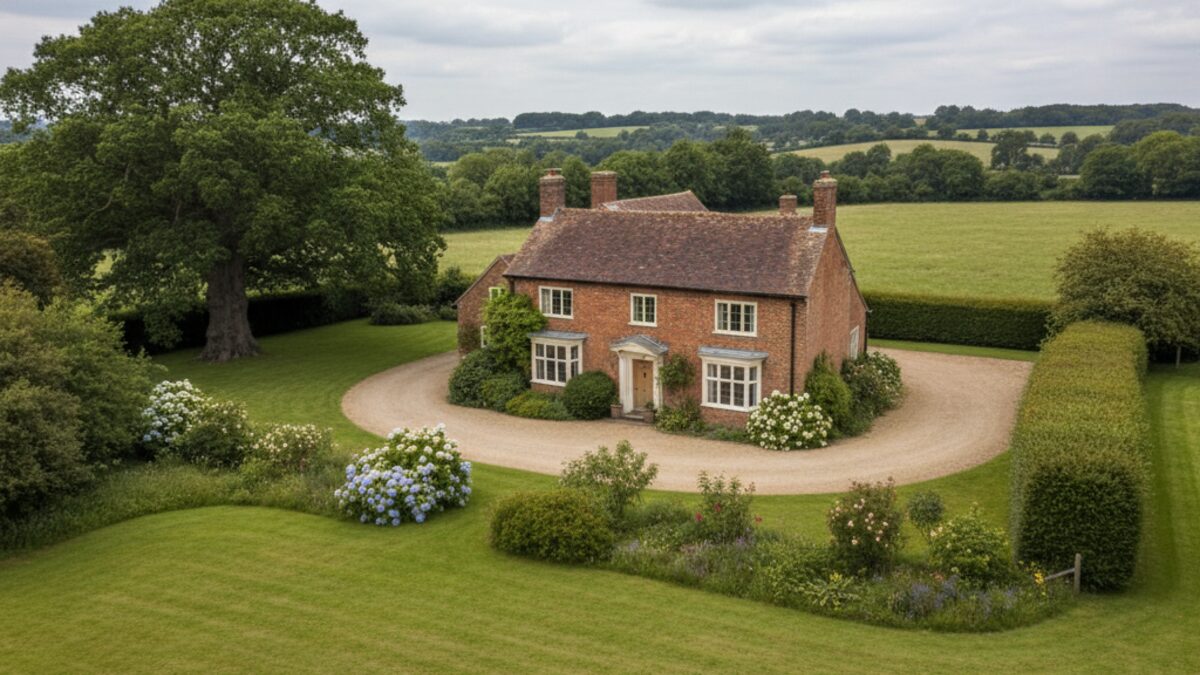
Drive through some parts of England and Wales and you might think the country was built around the three-bed semi. But the numbers tell a different story. In certain corners of Britain, the detached house does not merely exist. It dominates. This is not about the grand estates of the super rich, but the everyday brick-and-tile home standing alone on its own patch of ground, a quiet symbol of space and privacy.
The Detached Dream
The dream of a detached home runs deep in British housing culture. No shared walls, no neighbours thumping above, no one else's bins crowding your drive. It is the aspirational gold standard of property, the final upgrade. And while most of us will never reach it, in some postcodes it is not a dream at all, but the normal state of affairs. Nationally, detached houses account for 23.2 per cent of all sales in England and Wales. But look at the local figures and the national average melts away, replaced by something far more striking.
Where Detached Homes Rule
There are parts of the country where the detached house is not just common, but the majority. In Lincoln, the LN postcode area, a full 43.1 per cent of all property sales are detached. That is nearly twice the national rate. Peterborough, the PE area, is not far behind at 41.1 per cent. And the pattern continues in the cathedral cities and market towns of the Welsh borders and East Anglia. Brecon, LD, stands at 39.8 per cent. Shrewsbury, SY, at 39.2 per cent. Hereford, HR, at 38.8 per cent. These are places where a house standing alone is not a badge of wealth, but simply the way things are built.
| Postcode area | Sales that were detached |
|---|---|
| LN (Lincoln) | 43.1% |
| PE (Peterborough) | 41.1% |
| LD (Brecon) | 39.8% |
| SY (Shrewsbury) | 39.2% |
| HR (Hereford) | 38.8% |
| BH (Bournemouth) | 37.4% |
| CW (Crewe) | 36.4% |
| CO (Colchester) | 35.9% |
| WR (Worcester) | 35.9% |
| IP (Ipswich) | 35.8% |
Where They Are Rare
At the other end of the scale are the dense urban cores, and no place is denser than central London. In the WC and EC postcodes, detached houses are so rare that they account for just 0.1 per cent of sales each. The E postcode area does a little better, but only just, at 0.6 per cent. In these parts of the capital, the detached home is almost a myth, a vestige of a pre-Victorian past, crowded out by terraces, flats, and commercial buildings. The numbers do not lie. Detached houses in central London are a statistical rounding error.
| Postcode area | Sales that were detached |
|---|---|
| WC (London) | 0.1% |
| EC (London) | 0.1% |
| E (London) | 0.6% |
| SW (London) | 1.6% |
| W (London) | 1.7% |
| SE (London) | 1.7% |
| N (London) | 2.5% |
| NW (London) | 3.8% |
Why Here
The explanation is simple and it begins with land. A detached house needs ground to sit on: its own plot, its own garden, its own breathing space. That is a luxury in a city where every square metre is fought over, but far more achievable in the countryside or a small market town. Lincolnshire, the Welsh borders, and East Anglia have something London lacks: space. These areas tend to have lower population densities, more green belt or agricultural land, and planning regimes that historically allowed for more generous plots. The cathedral cities among them also have a long tradition of houses built for middle-class professionals, lawyers, clergy, and merchants, who wanted independence from their neighbours.
There is also a question of housing stock age. Many of the high-detached areas have a large proportion of older housing, including Victorian and Edwardian villas, as well as interwar semis and detached homes built on former farmland. Newer development in these regions often follows the same pattern: cul-de-sacs of four-bed detached houses aimed at families. By contrast, London's explosive growth in the 19th and 20th centuries was dominated by terraces and purpose-built flats, leaving little room for detached homes except in the wealthiest suburbs.
What It Means
The geography of the detached house tells a story about Britain's economic and social divides, but not the obvious one. It is true that detached homes are generally more expensive, but the dominance of detached houses in places like Lincoln and Hereford is not a sign of billionaire enclaves. It is a sign of moderate prosperity in lower-cost areas. The premium for a detached house there is smaller than the premium for any type of home in central London. So the dream of a detached home is far more achievable in the shires, even on an average salary, than in the capital, where even a flat can cost a fortune.
This also shapes local life. In high-detached areas, gardens are bigger, streets are quieter, and privacy is easier to find. But there is a cost: these places are often car-dependent, with fewer public transport links and longer journeys to shops and services. The detached dream comes with a trade off. You get space, but you may lose convenience. Londoners get the reverse: convenience, culture, and proximity, but often at the price of a shared wall and a view of next door's kitchen.
So the next time you look at a map of property types, remember that the simple detached house is a lens on how and where we choose to live. It is not just a building. It is a statement about land, history, and the old British desire for a patch of ground to call your own, with no one above, below, or, if you are lucky, too close beside you.