



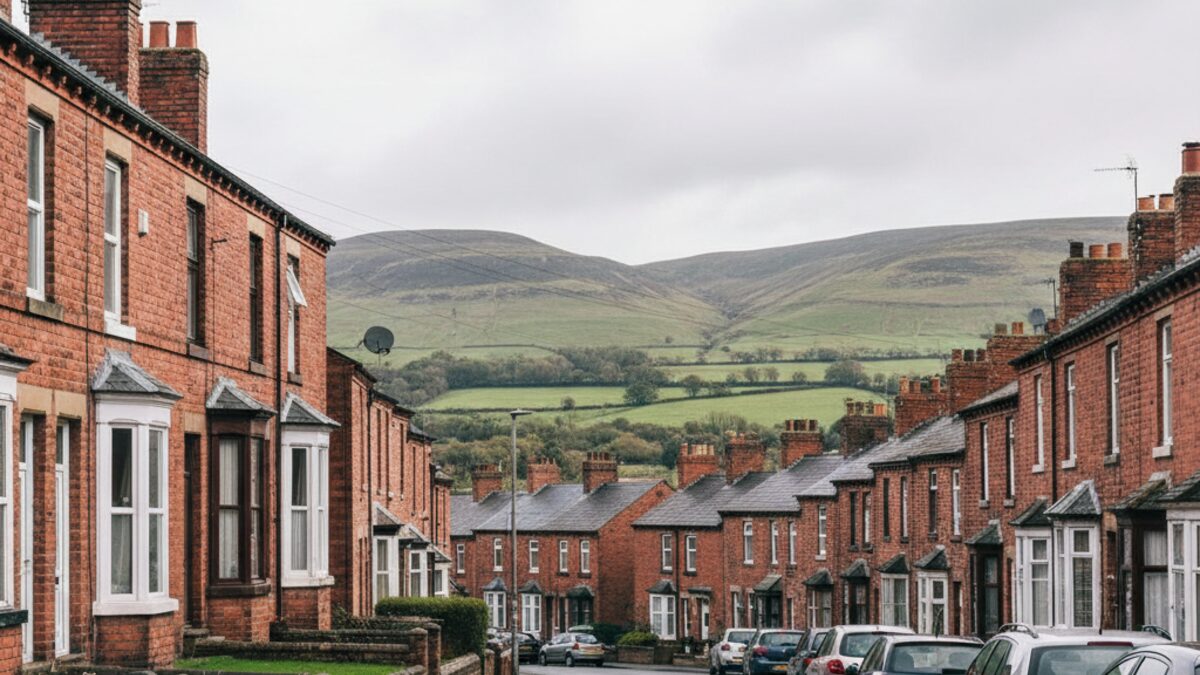
When you buy a house in England and Wales, you expect to own both the building and the land it sits on. That is the standard freehold arrangement. But for a surprising number of buyers, especially in the North West, the reality is different. They buy the house but not the ground beneath it, paying an annual ground rent to a landlord. Nationally, only 7.1 per cent of house sales are leasehold – flats are almost always leasehold, but houses rarely are. Yet in parts of Greater Manchester and Lancashire, leasehold houses are the norm. How did that happen, and what does it mean today?
The Leasehold House
A leasehold house is one where the buyer owns the property for a fixed number of years (typically 99 or 125) but the land remains with a freeholder. The leaseholder pays ground rent, which can be a modest sum or, in some cases, a rapidly escalating charge. The arrangement was once a standard way to develop housing estates, particularly in the Victorian and Edwardian eras. But as lease lengths shorten and ground rents rise, the drawbacks become clear: leaseholders can struggle to sell or remortgage, and they face unpredictable costs. The system drew widespread criticism, especially after investors began buying up freeholds and imposing onerous ground rent clauses.
The North West Heartland
Look at the map of leasehold house sales and one region stands out. In Bolton (BL), a staggering 62 per cent of all non-flat sales are leasehold. Oldham (OL) follows at 53.8 per cent, then Blackburn (BB) at 44.5 per cent and Wigan (WN) at 43.4 per cent. Manchester itself (M) records 36.2 per cent. For comparison, London (EC) comes in at 48.5 per cent, but that figure is heavily skewed by the capital's unusual mix of housing stock. The real concentration is in the North West, where towns such as Bolton, Oldham, Blackburn, Wigan and Manchester form a clear heartland.
| Postcode area | Houses sold as leasehold |
|---|---|
| BL (Bolton) | 62% |
| OL (Oldham) | 53.8% |
| EC (London) | 48.5% |
| BB (Blackburn) | 44.5% |
| WN (Wigan) | 43.4% |
| M (Manchester) | 36.2% |
| WA (Warrington) | 31.3% |
| SK (Stockport) | 25.3% |
| HD (Huddersfield) | 22.5% |
| S (Sheffield) | 17.3% |
| L (Liverpool) | 17% |
| W (London) | 16.5% |
Outside this region, leasehold houses are rare. The national average of 7.1 per cent is pulled down by most of England and Wales, where freehold is the default. A few non-northern outliers appear, but only where the total number of houses is very small, making percentages misleading. The North West dominance is no statistical fluke: it is a legacy of how land was developed there.
Why Here
The explanation lies in 19th and early 20th century land ownership patterns. In the industrialising North West, large estates owned by aristocratic families or industrialists controlled vast swathes of land around the booming towns. When housing was built for the growing workforce, landowners often sold the houses but retained the freehold, leasing the ground to builders or directly to occupiers. This allowed them to collect ground rents in perpetuity, a reliable income stream. The practice was especially common in Bolton, Oldham and Wigan, where textile magnates and landed gentry held onto their acreage. Over time, tens of thousands of houses were built on leasehold land, and the arrangement became embedded in local conveyancing custom.
Unlike in London, where leasehold was also widespread for flats and some houses, the North West model was overwhelmingly for terraced and semi-detached houses. The result is that today, when you buy a house in parts of Bolton or Oldham, you are more likely than not to be buying a leasehold, not a freehold.
Reform and Aftermath
The leasehold system for houses drew increasing controversy from the 1990s onwards, as ground rent clauses became more aggressive. Some freeholders inserted escalation clauses that doubled ground rents every decade, turning a nominal sum into a significant annual charge. Leaseholders found themselves trapped, unable to sell or remortgage without paying huge sums to buy the freehold. Campaign groups and MPs pushed for change, and the government eventually acted.
The Leasehold Reform (Ground Rent) Act 2022 banned ground rents on most new residential leases in England and Wales. It also made it easier for leaseholders to extend their lease or buy the freehold. But the reforms did not apply retrospectively to the millions of existing leasehold houses. For homeowners in the North West heartland, the legacy remains. Many are still paying ground rents, and the cost of enfranchisement can be high. The government has promised further reforms, including a cap on ground rents and a simpler process for lease extension, but progress has been slow.
What It Means
For buyers in Bolton, Oldham, Blackburn, Wigan and Manchester, leasehold is a fact of life. It is not necessarily a disaster: many leasehold houses have long leases and modest ground rents. But it adds complexity and cost. A leaseholder must be aware of the lease length, the ground rent terms and any future increases. Lenders are often wary of leases below 80 years, and valuations can be lower than for an equivalent freehold.
The North West's leasehold houses are a distinctive feature of the region's housing market, a relic of industrial-era landholding that has survived into the 21st century. Reform has taken the edge off the worst abuses, but the system remains. For anyone buying a house in this part of the country, checking whether it is leasehold or freehold is not just a detail – it is essential. And it is a reminder that the way land was owned a century ago still shapes the homes we live in today.