


Local authority leaders across Scotland are weighing up what could be the most radical redrawing of the council map since the mid-1990s. The proposals, still behind closed doors, are expected to suggest merging councils, cutting their overall number, or shifting boundary lines that have been in place for three decades. Several council leaders have already signalled they will resist any model that erodes local accountability or sees services centralised away from the communities that depend on them.
The discussion echoes a familiar tension between the drive for efficiency and the value of locally rooted decision-making. Smaller councils say they are better placed to reflect distinct community needs, while supporters of larger units believe amalgamation can savings and stronger strategic planning. With finances tight and populations shifting, the government is under pressure to show how any new structure would deliver better outcomes without losing public trust.
The scale question in reorganisation
| Town | County | Built-up area |
|---|---|---|
| Birmingham | West Midlands | 219.1 km² |
| Glasgow | Glasgow City | 138.1 km² |
| Leeds | West Yorkshire | 118.9 km² |
| Sheffield | South Yorkshire | 113.7 km² |
| Liverpool | Merseyside | 109.4 km² |
| Edinburgh | City of Edinburgh | 101.5 km² |
| Bromley | Greater London | 80.3 km² |
| Coventry | West Midlands | 77.7 km² |
| Hillingdon | Greater London | 76.4 km² |
| Manchester | Greater Manchester | 74.8 km² |
At the heart of any boundary review sits a simple but stubborn question: how big should a council area be? Answering it requires looking at both administrative geography and the physical reality on the ground. One useful lens is built-up area, a measure that captures continuous urban fabric, ignoring political lines. A built-up area might sit entirely inside one council, or it could spill across several, mixing oversight and complicating service delivery. In debates about council mergers, understanding the sheer physical spread of where people live and work is vital.
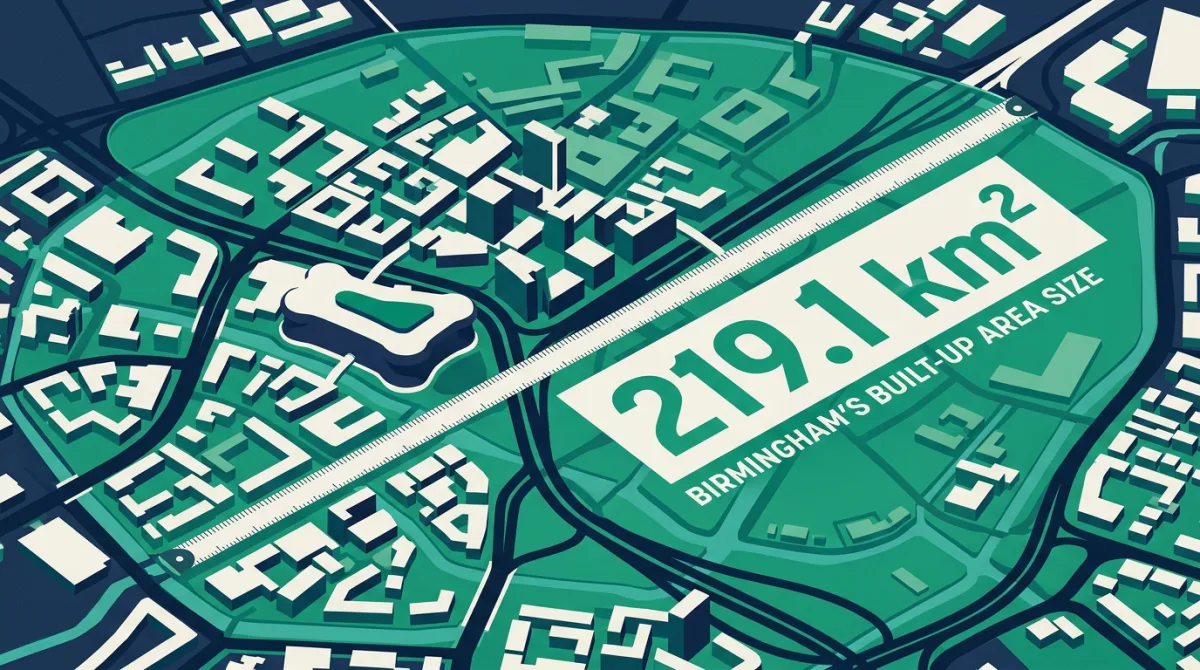
While Scotland’s discussions focus on its own map, the largest built-up area currently recorded in Britain’s rankings is a long way from the central belt. Birmingham in the West Midlands covers 219.1 square kilometres of continuous bricks, tarmac and green spaces woven together, making it the most physically extensive town in the table. That figure reflects a single urban footprint, not an administrative boundary; the actual City of Birmingham council area is larger still because it includes built-up areas that are separate from the core conurbation. For anyone sitting in a town hall considering how to restructure council boundaries, a number like 219.1 square kilometres is a starting point for thinking about the geography a single council might be asked to serve.
Birmingham’s footprint and the boundary debate
When planners look at a built-up area spanning 219.1 square kilometres, they see a region where transport, housing and economic links cross ward and constituency lines daily. The sheer sise can make a case for unified strategic leadership, but it also raises questions about whether one town hall can stay in touch with neighbourhoods on the edges. This is precisely the dilemma echoing through the Scottish consultation: how to balance the breadth needed for effective planning with the closeness that keeps local democracy alive.
In the West Midlands, Birmingham’s built-up area already interacts with multiple neighbouring authorities, from Sandwell to Solihull. That patchwork arrangement shows that even when an urban form is physically vast, governance can remain fragmented. As Scotland’s council leaders digest their own reform options, the Birmingham figure serves as a reminder that the lowest common denominator is not just population or budget figures, but the actual miles of roads, housing estates and industrial parks that any council must look after. Whether the answer is fewer, larger councils or a different kind of partnership, the physical dimension cannot be ignored.
The data behind this
The built-up area ranking used here is drawn from Postcodes UK’s analysis of official geographic data. The figure for Birmingham confirms it as the largest town by built-up area in the current ranking, at 219.1 square kilometres. The wider discussion of Scotland’s local government reform is based on reporting by BBC Scotland and the responses of council leaders to the proposals. No land registry sales data informed this article.
In response to reporting by BBC Scotland. Analysis and figures by Postcodes UK.